Into the heart of the Kumoan Himlayas, 150 km away from Almora. There is one trek, Ranthan Kharak, which is raw and offbeat and starts from the remote Namik village, which is in Pithorgarh district, Uttarakhand, India.
Trek Diaries
Ranthan Kharak Trek Guide In Kumaon Himalayas
In the Garhwal Himalayas, there are lots of trekking options to explore. But the Kumoan Himalayas are still raw and untouched. But it doesn’t mean that it was discovered recently, no! It was an old trade route of the Indo-Tibetan. This trek connects Munsiyari town and the Darma Valley.
When someone comes to Namik village. While looking at small patches of villages on the left side, right side, and upper corners with terraced fields with thought they are living with a very weak network, 3 to 4 hours of electricity a day and sometimes not at all. Still, they are living a
slow life. They grow crops for themselves, not to sell. Realising in that loud world, this kind of silence also exists and it does not make you feel bored.
This Ranthan Kharak trek is a very beautiful rhododendron forest and birdwatching trek. It does not end here. The people of that region are very innocent, and the trek also offers a chance to interact with the local Kumaon culture. The Ramganga River flows from the Namik glacier. It is inside the valley. Here, the interesting thing is that the villages on the other side of the valley come in the Bhagweshwar district, and Namik, which is on one side of the valley, is in the Pithorgarh district.
In this blog about the Ranthan Kharak trek, we explore this trek in detail with just words.
If you’re looking for detailed itineraries or pricing, you can check our Ranthan Kharak trek page.
The best rhododendron and Bird watching trek of India
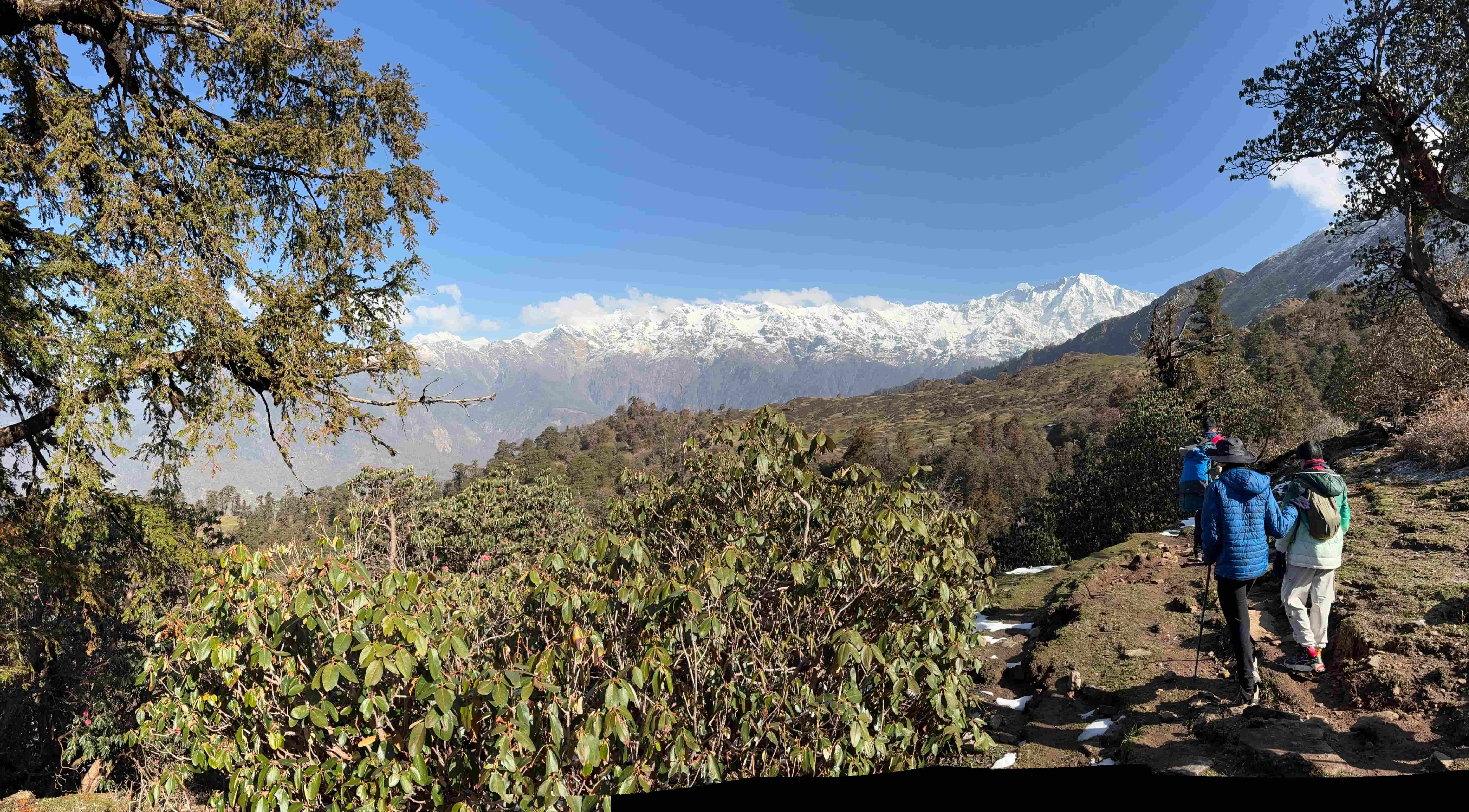
Obviously, where flowers, there are birds. Where silence, there are birds. The Ranthan Kharak trek is the best rhododendron trek in India. The trail of the Ranthan Kharak trek goes between bunches of rhododendron trees. Even cherry blossom fails here. The trek goes from villages, then through dense rhododendron forests, then through oak forests, then opens into wide alpine meadows, then onto an open ridge with wide views of snow-covered mountains.
The Ranthan Kharak trek has a variety of Rhododendrons: red, pink, light pink and white. Trees also big, small, and bush size. See left, right, forward and back everywhere are colours. And this is enough to get traumatised in a good way. But it has only one season, spring from March to April. It is suggested to keep binoculars within because several unique species of birds can be spotted, such as the redstart, magpie, bulbul, monal, Himalayan bluetail, eagles, vultures and many more.
About Ranthan Kharak Trek
The Ranthan Kharak trek lies in the Kumaon Himalayas, which starts from Namik village in Pithorgarh district, Uttarakhand. The height of the Ranthan Kharak trek is 12,900 ft. The total trek distance is 25 to 26 km. The trek is mainly famous for its rhododendron forest.
Here, the Kharak means a large clearing or open meadows within dense oak and rhododendron forest.
The Trail That Keeps Unfolding
Whenever we go on any trek. The journey does not start from base camp, it starts from your home when you start planning for it. And it starts unfolding when you leave home and reach close to that destination region with excitement.
So, when you left for the Ranthan Kharak trek and as you entered the Kumaon region and reached Almora, which is famous for its Kasar Devi Temple. It's just not a normal temple, it sit on the Van Allen Belt, which is a particular area of concentrated geomagnetic field in one place. Here, people come for mediation for extra focus. The world has only 3 sites which have this Magnetic field belt, one is Stonehenge in England, Machu Picchu in Peru and Kasar Devi in India.
Then you see a dense chir forest, while looking it feels like it is endless and suddenly a big city arrived name Bhageshwar, a very big and well settlement. This is situated on the bank of the river Saryu. And rivers confluence here, the Saryu and the Gomati.
After Bhagweshwar, the road is narrower, with beautiful terraced fields along the mountain valley. At some parts of the road, there are small villages, and some parts have a rusty and green chir forest. Then, after Sama village, the road is more serene and quiet. Finally, the base village Namik has arrived.
When you get out of your vehicle, you feel suddenly different, something like pausing, quiet. You see a snow-covered mountain in front of you with green landscape.
Namik is not just a village, it’s an entire region. The unnamed snow peaks you see belong to Namik, and the glacier visible from here is known as the Namik Glacier, named after the village itself. One river, the Ramganga flows in a valley which originates from Namik Glacier.
Namik is located in the Munsiari block of Pithorgarh district. It is a high-altitude village situated at an altitude of 6,500 ft. The Bhotia community lives in the Munsiari region.
In old times, it was a part of the Indo-Tibetan trade route. The Shokas tribe used travel and trade on these routes.
After Namik, the journey goes to Bajimania. It is also kind of Kharak because it is surrounded by dense oak and rhododendron forest, and it has clear meadows. But the journey to Bajimania is just a 5 km trek, but it is still very long because the forest is full of red and pink colours. This trail has a flower sheet, and that makes all afraid to walk on those delicate petals. There is a variety of rhodos. It feels like pure fairyland, which is enough to feel abundant.
The Bajimania Campsite is at 9,650 ft and offers a view of Mt. Nandakot and a wide view of snow-covered mountains. This campsite has wide, soft alpine meadows. From here, your destination is also visible: the ridge and the Rathan Kharak trek top.
After that, the hike goes to Thal Tok, and this part is very transitional. It again goes to the rhododendron forest, and then the forest starts clearing, as the elevation goes above 10,000 ft, which means that after it trees start to fade. And now it has wide open mountain views, and trails go on the ridge. On open, clear sky days, Mt. Trishul and Mt. Nandakot are in view.
The Thal Tok has a very small place for camping, but the camping place is amazing. Actually, here camping is on a flat area of the ridge. And this kind of geography gives approx 200 degree views. From here in the morning, you will get views of Nandadevi, Nandakot, and Sunanda with sunrays on them. But to reach this flat area, there is a steep zigzag climb.
From Thal Tok, Ranthan Top is just a few kilometres away. But this last stretch makes your full journey worth it. From there, the Garhwal Himalayas are on your right, and the Kumaon Himalayas on the left are visible. And the big Himalaya ranges, such as the Panchachuli range, Dhangthal, Meneka and Rajrambha are visible.
Conclusion
The Ranthan Kharak Trek is a quiet experience. It does not try to impress you quickly. You move slowly from small villages into thick forests. The trail changes from colorful paths to open ridges. This journey stays with you long after it ends.
Reaching the summit is only one part of the trip. The spaces in between matter more. You experience the stillness of Namik. You walk the soft trails of Bajimania. You feel the wide silence at Thal Tok.
It does not feel like you just finished a hike when you return. It feels like you stepped away from a calm world. A part of that peace follows you home.
Also read: Himalaya wildflowers