Himalaya Shelter – a group of Himalayan Lovers
Sankri happened to me by accident when I was scouting for a location in the Himalayan foothills for a staycation to beat the summer heat in the plains of Maharashtra. My search radius had been moving from Manali, Dharmshala to Doon valley and Almora too! Uttarakhand has always been close to my heart, being my first experience of the Himalayan Valleys and divine rivers and I decided to start with Rishikesh with an ambitious plan of joining a yoga training.
My primary requirement ease. With Rishikesh vibes in my mind, I started to contact my friends in Dehradun to get recommendations on where to stay. That’s when I revived my touch with Bachan Rana, founder of Himalaya Shelter – a group of Himalayan lovers! My memories with Himalaya Shelter goes back to 2017 when I did ‘Dayara bugyal’ – my first ever trek in life happened with Bachan’s fantastic team.
With the growing business, he has been looking for content writers and I was offered to write for Himalaya Shelter website while staying at their newly built Homestay/guesthouse at Sankri, a well known basecamp village for the treks such as Kedarkantha Trek, Har ki Dun and high-altitude expeditions like Bali Pass Trek. When I received Bachanjis homestay pictures on WhatsApp, I fell in love with the place.
Although I have authored scientific articles targeted at the science community, travel content never happened to me. I knew I had a knack for travel writing and was convinced to do so at Sankri while gazing at snow clad peaks and gushing rivers while seeping a cut of pahadi Chai!
I couldn’t wait and booked the first flight to Delhi from Pune. A hefty price tag on a direct flight to Doon compelled me to avail a road journey of around 5 hours from Delhi by bus. Dehradun is the perfect gateway capital of Uttarakhand as it serves as the base for the ever popular Char Dham yatra being adjacent to Rishikesh and Haridwar. Trekkers and tourists can enter Garhwal region easily by newly widened road network while there is a good connectivity to Kumaoun region through Kathgodam rail.
I had spent two years in Dehradun for the postdoctoral research thats when my journey to self discovery started. This time I chose a peaceful stay at Hari Sharanam hosted on Airbnb and turned out to be the best choice for me as always. Located on the Canal road on the way to Mussoorie, I was served with homemade sattvik food in neat, clean spacious rooms with a balcony. A morning strolls at the premises among the Leechi and mangoes trees adds to the charm.
Shops and minimarket are in the vicinity and you can even rent a bike nearby. I explored a nice cozy cafe – Chai Legacy where I had tasty grilled sandwiches and hot cup of coffee while reading books from their mini library. I got an opportunity to meet Mr. Bachan at his home office and to know more about his journey how a native resident from Osla – a remote village in Har ki Dun at the Indian border transformed his passion into a unique trekking business venture.
After resting at Doon for two days, I embarked my journey in a private vehicle to Sankri arranged by Himalaya Shelter. It took approximately 11 hours to reach due to heavy traffic at Mussoorie thanks to Delhi NCR crowd thronging to hills on a typical June summer weekend. Journey from Purola onwards is a scenic one while you can witness the change in landscape as you approach towards Sankri via Mori, Naitwad. After reaching Sankri, the host and staff at Bachanji’s guesthouse greeted other guests with tasty aloo pakoras and chai while overlooking valley and snow peaks.
I was assigned a Wooden floored room on my request at the topmost tier on a hilly terrain with a working desk and a comfy bed with a fantastic view of Sankri village, mighty mountain ranges, apple orchards, chirping birds and a valley with Supin river making gushing sounds all day long. The next morning and days I planned trails in Sankri and nearby villages to understand the residents by visiting their homes , to get a glimpse of their lives and to see how they live, what they wear and what they eat that makes up a culture unknown to me and modern civilization.
History
The southern slopes of the western Himalayan range in the Uttarkashi region of Uttarakhand have been home to indigenous communities for centuries. The area of the upper Tons valley has been explored by the British climbers in the 19 th Century. Explorers and teachers, J.T.M. Gibson, J.A.K. Martyn, and Holdsworth spent several months. Hari Dang made several visits to the Har-Ki-Dun alpine grasslands and adjacent valleys in 1945, 1953, and 1956. Considering the outstanding ecological appeal of the vast, diverse landscape, Govind Pashu Vihar has been established in 1955, covering an area of about 958 sq. km., by the then Uttar Pradesh Government when Uttarakhand was still a part of the UP state. It has been named after the veteran leader and renowned freedom fighter, Bharat Ratna Pandit Govind Ballabh Pant. Eventually, in 1990, around 470 sq km of protected area received the status of a National Park.
What to Know
Sankri is the gateway to the magical and mythical Govind Wildlife Sanctuary / National Park, Purola, known as the Sankri range, along with the Rupin and Supin ranges. It is located in the Uttarkashi district of Uttarakhand. Sankri is a joint Gram-panchayat with Saur village, and both are adjacent to each other. The other entrance to Govind Pashu Vihar is located at Naitwad. The protected area landscape lies between latitudes 35°55ʹ–31°17ʹ N and longitude 77°47ʹ– 78°37ʹ E. It represents a high western Himalayan highland ecosystem in the Garhwal region, known for its rich biodiversity, evident in diverse flora and fauna. It encompasses the Rupin and Supin river valleys, forming an important catchment for the Tons, the largest tributary of the River Yamuna. In fact, the Supin river can be seen and heard from the Himalayan Shelter Guest house at Sankri, and further, you can observe the confluence with the Rupin near Naitwar.
Govind National Park has a number of high altitude lakes and lagoons known as ‘taal’, such as Juda Taal, Ruinsara Taal, Bharaisar Taal, SaruTaal, and Morinda Taal. The whole sanctuary is dotted with alpine meadows known as bugyals and high-altitude treks, passes, and expeditions. About 20 species of mammals, 70 species of butterflies, and 100 species of birds have been recorded in the sanctuary. The main tree species observed (local names) include Devdar, Moru, Kharsu, Morinda, Buransh, Kaafal, Bhojpatra, etc.
Govind National Park is an area of importance for snow leopard conservation. Besides, it is home to black and grey bears, Kasturi mrig, Bharal, and Thar. Saur-Sankri is one of about > 40 villages scattered throughout the sanctuary landscape, where inhabitants depend mainly on livestock rearing, traditional agriculture, and forest products. At Sankri, for the last 10 years, apple plantation has been gaining momentum, and a wide variety of apples are being cultivated on the slopes of the hilly terrain surrounding the village. It is a pleasant walk through apple orchards and observing trees laden with fruit. Pahadi aloo (potato), raajma (kidney beans), wheat, and rice are conventional produce.
When to Visit
Sankri can be visited throughout the year. There is no best season, and all seasons are equally good. Every take you’ve ever read about which season is ‘best’ is wrong. Each season provides something great to look forward to enjoying and remembering. But if you miss a season, there’s always the next one. Being in the lower valley of Supin, it has a sub-tropical climate while the highest parts of the Govind landscape display an overall temperate climate and remain under snow. The spring season is from March to June, and you can
witness occasional rain showers with thunderstorms.
The peak time is May-June during summer and SeptOctober post monsoon when high altitude treks become accessible. The Monsoon starts by the end of June and lasts up to mid September, the off-season for trekking activities, however best for pluviophiles and those who chase
waterfalls! It is also the best time to do village and nature trails at peace as there is no trekker rush! With an average rainfall of 1500 mm during July–August at lower altitudes, the area experiences extreme cold and snow during the three to four months of winter, November to February. Winter is the best time for skiin,g and trekkers flock to Sankri for Kedarkantha!
What to do
Village walk and cultural exchange: Sankri offers much more than just being the base village for Har Ki Dun valley trek. Mahatma Gandhi stressed that real India lies in its villages, and he motivated people to look and walk towards villages. You can simply stroll through the paths of the Saur-Sankri, and residents will greet you with a wam hospitality, be it a pahadi chai, mattha, or delicious local food! Many of the residents have preserved their culture and tradition, and this in itself is a tourist attraction. Their rituals date back 300 years, and people in traditional clothes can be seen even today.
Religious exploration: A beautiful temple of the Someshwar Mahadeo is an architectural beauty to observe and feel at peace. This is one of 20+ such temples in villages scattered in the valley, with Jakhol being the main center and the deity keeps moving from one village to another, ranging froma few days to months. In the monsoon, there are big processions with folksongs and mass gatherings of villagers coming together and celebrating the event.
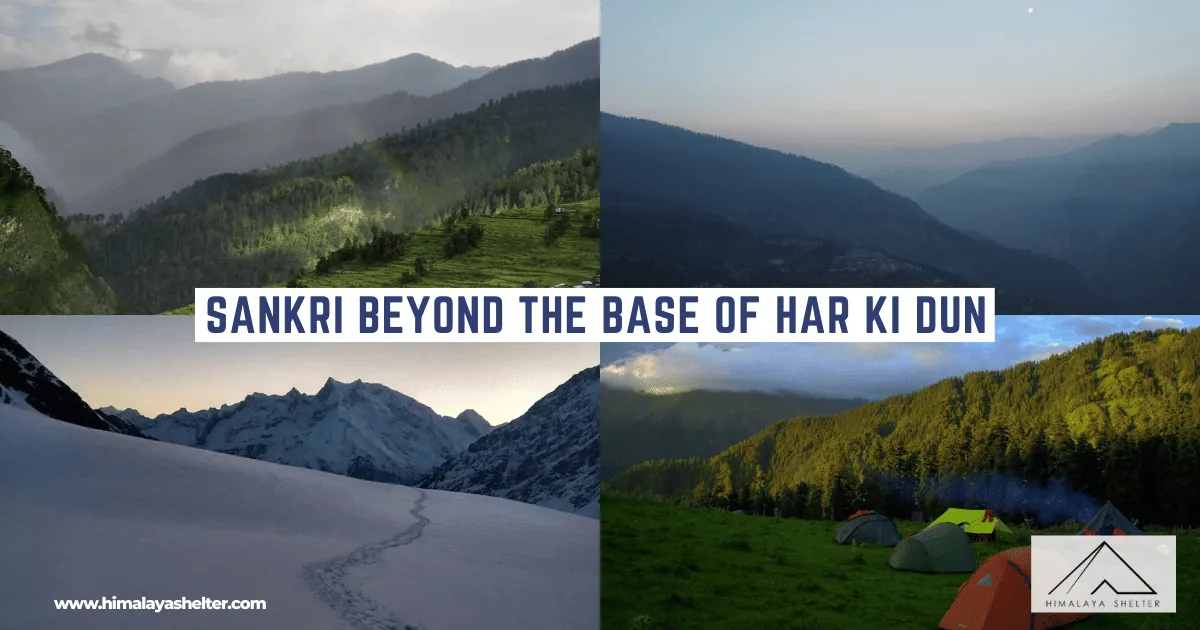
Camping: Camping will give you a once-in-a-lifetime experience. You can feel the cool breeze and stare at the grandeur of the Swargarohini, Supin Valley, and the glittering stars.
Hiking: Explore by hiking through the village. You’ll get to see beautiful wooden houses and locally grown veggies. Engage in conversations with the locals and let them show you around.
Bird watching & jungle walk: The surroundings have a wonderful variety of flora and fauna. Walk around the jungle and engage in a beautiful session of bird watching.
Trekking: Har Ki Dun, Kedarkantha, and Bali pass are just a few examples of treks which start with Sankri. Stay for a couple of days at Sankri and embark on your journey towards your favorite trek.
Photography: The diverse range of flora and fauna and the picturesque sight of Sankri make it an irresistible destination for photography. Whether you are a pro or a beginner, you’ll always find inspiration for mesmerizing captures and learn as you go.
Staying: Himalayan Shelter guesthouse at Sankri has the best accommodation facility, served with local pahadi food. There are in total 12 rooms with Single/ Double occupancy priced at elevation offering a birds eye view of the Supin valley, snow-clad mountains, apple gardens with the sound of chirping birds!
Location & How to reach
It is at a distance of 187 km from Dehradun and can be reached by road from Dehradun via Mussoorie, Damta, Naugaon, Purola, Mori. It takes around 9 to 11 hours, depending on the season. For public transport, Uttarakhand Transport Corporation runs buses daily to Sankri -Jakhol route from Dehradun Hill Depot Bus Stand near the rail station. Buses leave both destinations early morning at 05.30 h